


Most Garba guides hand you a list of features. This one names the problems you’ll actually face on the busy nights — and what it takes to solve them.
You can book the best artist, build the best stage, and sell out all nine nights. None of it matters if the gate falls apart.
By 9 PM on a peak Navratri night, the floor is full, the music is loud, and the only thing standing between a great evening and a flood of angry WhatsApp messages is a row of volunteers scanning passes under a tent. That’s where your event is actually judged. Get the gate right and people come back next year. Get it wrong and they remember the forty-minute queue, not the dandiya.
So instead of another list of “key features,” here’s the honest version: the things that break at the gate during Navratri, and what it actually takes to stop them.
1. Fake and screenshotted tickets
This is the big one in Gujarat. One real pass gets bought, a screenshot gets forwarded into three family groups, and suddenly six people are showing the same QR code at the gate. Your volunteer can’t tell the original from the forward. Every duplicate that walks in is gate revenue you’ll never see — and a problem for your sponsors, who paid for a certain footfall, not a leak.
What fixes it: a QR code that doesn’t exist until you say so. If the pass only becomes scannable at a set date and time — not the moment it’s bought — there’s nothing to screenshot and share early. Each code resolves once. The duplicate gets stopped at the rope, not after it’s already inside.
2. The group that booked together but arrives apart
One person buys six passes for the whole group. Three of them show up at 8, the rest are still parking, and now the early arrivals are stuck at the gate holding everyone’s tickets — or waiting outside so they can all walk in together. The queue behind them stops moving.
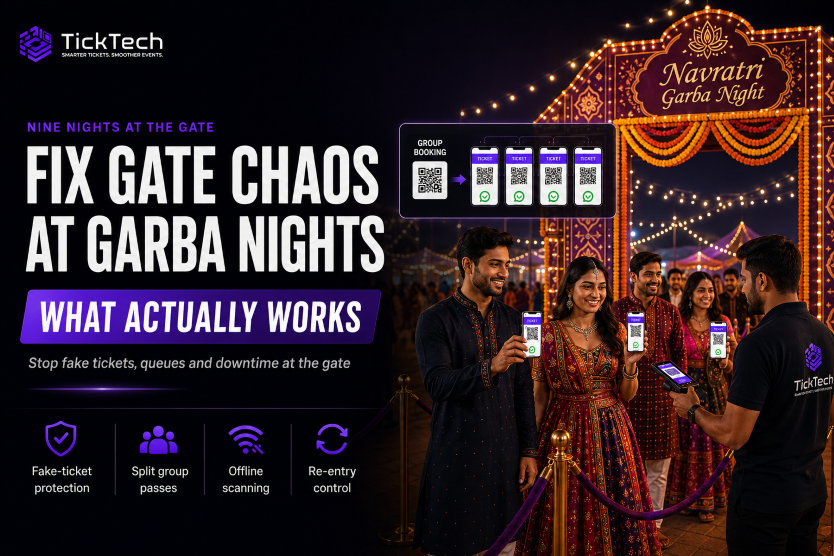
What fixes it: let the buyer split the booking and send each person their own pass. Latecomers walk straight up with their own QR on their own phone. No huddle at the entrance, no holding the line for stragglers.
3. The network drops at exactly the wrong moment
Big outdoor grounds, thousands of phones, one overloaded tower. The moment footfall peaks is the moment your data signal dies — and if your scanning app needs the internet to work, your gate freezes solid with a hundred people waiting.
What fixes it: scanning that runs offline. Passes should validate on the device itself and sync up once the connection returns. A manual entry mode as backup means that even in the worst case, a volunteer can keep the line moving by hand. Zero downtime, whatever the network is doing.
4. Re-entry no one planned for
People step out — for the car, for food, to drop a tired kid home — and then they come back. Without a plan for this, you get arguments at the gate, double-entries, and volunteers making judgment calls they shouldn’t have to make.
What fixes it: controlled re-entry with pass validity built in. The same pass works for a genuine return, the system tracks it, and there’s no loophole for one ticket to quietly become two entries.
5. Parking, location, and the pre-event call flood
Half your gate chaos starts before anyone reaches the gate. Attendees can’t find the venue, don’t know where to park, so they call your team — right when your team is busiest setting up. Multiply that by a few thousand people and your phone becomes its own bottleneck.
What fixes it: push the answers out before they ask. A WhatsApp message to every registered attendee with the location pin, parking details, gate timings and any last-minute updates cuts the call volume sharply and gets people to the right entrance in the right mood.
6. Sponsors who want more than a banner
Your sponsors are paying for visibility. A banner on the stage is fine, but the one thing every single attendee actually looks at — repeatedly, all night — is their own entry pass.
What fixes it: put your sponsor’s logo and branding on the e-pass itself. Every time someone opens their pass to get scanned, that’s another impression delivered. It’s premium placement your partners will notice, and an easy reason to renew next year.
The point
Selling tickets is the easy part — plenty of platforms do it. The hard part is the gate: nine nights, patchy networks, fakes everywhere, and a crowd that judges your entire event by how the first ten minutes felt.
That’s the part worth getting right. Lock your QRs so they can’t be shared early. Scan offline so the network can’t stop you. Let groups split their passes, let genuine re-entries through, get people to the venue before they call, and give your sponsors something better than a banner.
Do that, and the nine nights run themselves — and your attendees remember the Garba, not the queue.
Running Garba this Navratri? TickTech is built for exactly this — the chaos of the gate, not just the checkout. Book a free demo and see how one platform handles all nine of your nights.